Workflow 01 / Reporting assistant

Your company knowledge, answered and checked.

A company-specific internal AI assistant configured around the knowledge and business data your team already has: product documents, exported correspondence, structured spreadsheets and the business rules your team saves. Reporting on sales and stock exports is the use case shown on this page.

No ERP replacement and no retrained model. Answers show their sources and a person reviews them before anyone relies on them.

Works from documents and spreadsheet or CSV exports, including exports from ERP systems.

Ten-second illustrative film for the internal assistant: records become one reviewable answer with its context.

Try the guided demo See the assistant layout
BUILT AROUND YOUR EXPORTS

Customer-order review

Stock-movement review

Product-code grouping

01 / What it is configured around

Your knowledge.
Your rules.

Company-specific by design
Nothing outside what your team agrees
  • Sources your team chooses: product documents, price lists and specifications, exported correspondence, competitor notes and structured business spreadsheets such as sales and stock exports. How they get in.
  • Saved business rules and corrections: when the team corrects an answer or records how something is done, that rule is kept and applied next time. The assistant adapts as your team adds knowledge and saved feedback; the underlying model is not retrained and no accuracy is guaranteed.
  • Reviewable answers: every answer shows the document, row or rule it relied on, so anyone can check it against the source.
  • Business data analysis: questions across spreadsheets and exports, such as which accounts are late against their usual interval or how one product family is moving across codes.
  • Team responsibilities: who owns which knowledge, who reviews outputs and who can save a rule, agreed before build.

02 / How your information gets in

Three routes in.
One proven, two scoped.

The assistant is only as good as what it can read. Here is what has been done, what would be scoped for your systems, and what you would need to provide.

Confirmed in delivered work

Upload the exports and documents you already have

Your team exports from the systems it uses and uploads the files. The assistant reads them, shows what each file can answer, and asks a person to confirm before the figures are trusted.

  • Spreadsheets: Excel workbooks including multi-tab files and SAP exports, and CSV files
  • Documents: PDF and Word files such as product sheets, price lists and internal guidance
  • Correspondence: emails exported from your mail system

You provide: the exports and documents, and a person who can confirm what they contain.

Available to scope

Scheduled refresh of the same exports

If your team already runs a weekly or monthly export, the same files can be picked up on a schedule from an agreed shared folder or mailbox instead of being uploaded by hand. The confirmation step stays.

You provide: a regular export your team is happy to keep running, and a folder or mailbox it lands in.

Not yet delivered for a client; scoped per business. It does not read your systems directly.

Available to scope

A custom connection to a source system

Where a system offers an interface and your IT team can grant access, a bespoke connector can pull agreed data on an agreed schedule, so the assistant works from the system rather than from files.

You provide: the source system’s interface details, access approved by whoever owns it, and the fields you want read.

Subject to the source system, its access rules and a separate scope. No native connectors exist today and no live SAP link was part of the delivered work.

03 / What the team sees

Ask in plain words.
Check the source.

The internal assistant delivered for a client, reproduced with its layout and navigation unchanged: chat history and search, the dataset selector, the training area, and an answer with its sources. Branding and content are replaced; no client data appears. Read the customer story.

YOUR COMPANYInternal GPT
  • New chat
  • Search chat
  • Which accounts are late against their usual interval?
  • Please analyse these sales and stock exports for Q3
  • Show me stock where the receipt was in the last 14 days
  • What is the difference between DEMO-F01 and DEMO-F01-B?
  • Do you know the 2026 price list rate for PT-48?
  • Can you give me a list of customers who ordered BX-40 this year?
  • Summarise the supplier correspondence about delivery dates
  • What causes the variance on the Q2 stock report?
Train your agentYOUR COMPANY
Use:Sales history by customer, to 31 August 2026Sales analysis 2026 (Aug 26)Sales analysis 2026 (Jul 26)Sales analysis 2026 (Jun 26)Stock movements Q3 2026Stock movements Q2 2026Price list 2026Product data sheetsSupplier correspondence (export)Team rules

Which accounts are late against their usual ordering interval this week, and what should I check before calling?

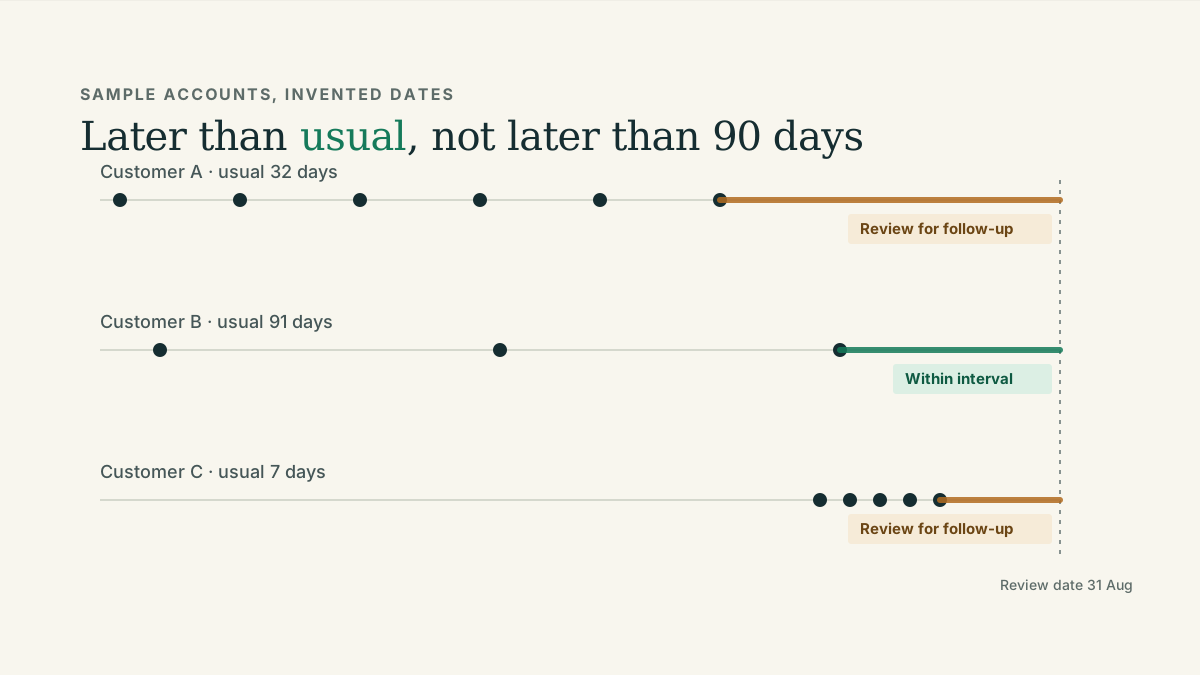
Two accounts are later than usual at the 31 August review. Customer A is 84 days on against a usual 32; Customer C is 21 days on against a usual 7. Customer B is within its interval.

Before calling, team rule 14 says to check for a partial return in the last 30 days and for an open price query. Customer A has a credit note on 12 August for two damaged units; the original order stays in the interval calculation.

  • SourceSales history by customer, to 31 August 2026 · rows 118 to 142
  • SourceSales analysis 2026 (Aug 26) · credit notes, row 7
  • RuleTeam rule 14: partial returns, saved by Sales on 2 September
Ask about your business data, documents or rules

Sample content throughout. Your own build would use your sources and your rules.

04 / Reporting use case

Three workflows.
Start with one.

The use case shown on this page. Each is a defined piece of work with agreed rules, agreed exclusions and a check against your source records before handover.

01

Customer-order
review

Compare each account’s days since last order with its own usual ordering interval, not a blanket cut-off. Returns, cancellations and one-off machinery lines are treated separately. The output is a short list for a person to review before anyone calls.

Weekly list for sales
02

Stock-movement
review

Read dispatches alongside receipts and on-hand quantities so a fresh delivery is not mistaken for slow stock. Agreed periods, agreed exclusions, totals reconciled to the source report.

Monthly or weekly stock review
03

Product-code
grouping

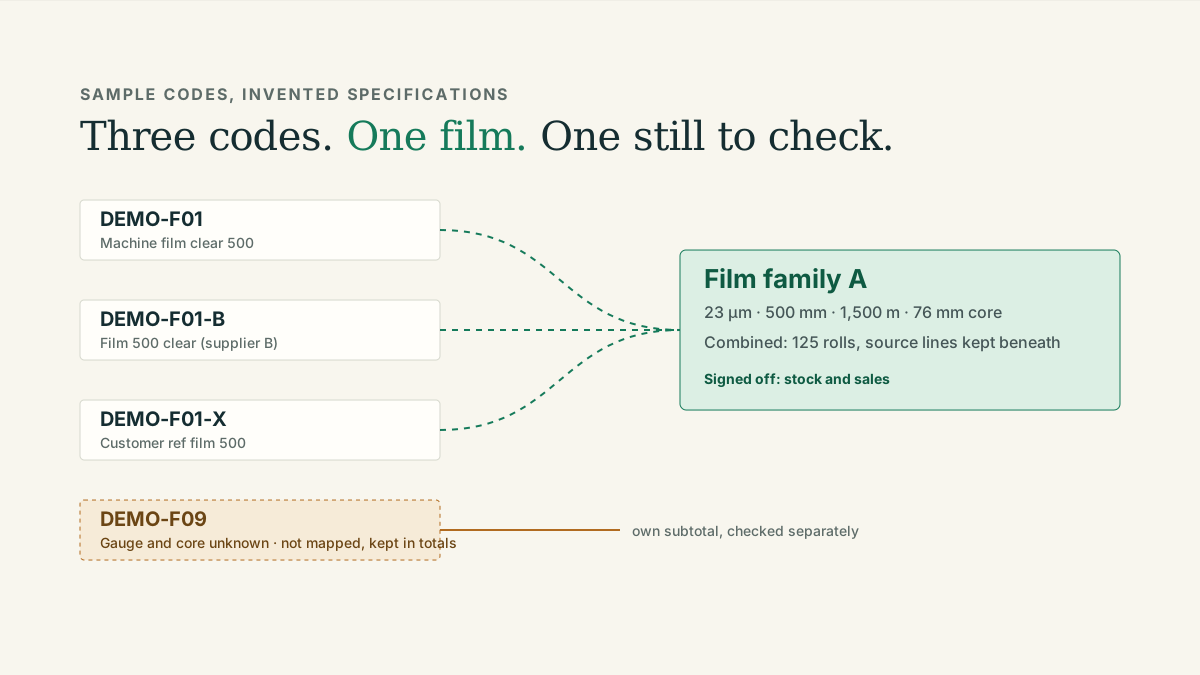
Equivalent products sold under several codes are mapped to agreed families, with matching units and specifications signed off by your team. Review the family as a whole while keeping every source line visible.

Agreed mappings, kept in view

Interactive example

From scattered lines
to something you can use.

Explore three examples of the questions a reporting assistant could help your team review.

Reporting examplesReview date: 31 Aug 2026

Who might be due a conversation?

Compare days since the last order with an agreed ordering interval.

Swipe sideways to see every column.

Illustrative customer order review. All businesses and figures are invented.
Sample customerUsual intervalSince last orderReview
Customer A30 days52 daysWorth a look
Customer B14 days26 daysWorth a look
Customer C30 days18 daysWithin interval

A prompt for a conversation. An overdue reorder is a signal to review, not proof that a customer has been lost.

Example rule: flag orders beyond the usual interval. Real thresholds and seasonal exceptions would be agreed with your team.

Is it slow stock, or a recent arrival?

Read dispatch history alongside receipts before deciding what to investigate.

Swipe sideways to see every column.

Illustrative stock movement review. Figures and products are invented.
Sample productDays since dispatchDays since receiptReview
Film family A95120Review movement
Film family B955Recent arrival
Film family C1228Recent dispatch

The same headline can tell a different story. Family B needs the recent receipt considered before it is flagged as slow stock.

Example rule: review after 90 days without dispatch, excluding receipts in the last 14 days. Rules are illustrative.

What changes when equivalent codes are grouped?

Keep each source line and review the product family as a whole.

Swipe sideways to see every column.

Illustrative product-code mapping and stock in rolls. Codes and values are invented.
Sample codeAgreed familyOn handUnits
DEMO-F01Film family A80Rolls
DEMO-F01-BFilm family A45Rolls
Combined viewFilm family A125Rolls

One family, with the detail preserved. Review 125 rolls together while retaining both source codes for checking.

Example only: equivalence and units must be confirmed by the team. Similar-looking codes are not automatically the same product.

This is a demonstration of the approach. Your assistant would be configured and checked against your own agreed workflow.

05 / Inputs and outputs

What you give.
What you get back.

Nothing to prepare for the first call
We can talk it through with sample data

Inputs

  • Sales export by order or invoice line: customer code, date, document type, product code, quantity, net value, and any returned or cancelled flag.
  • Stock export: product code, on-hand quantity, receipts and dispatches with dates, and the site or warehouse if you hold more than one.
  • Product list: code, description, unit and specification fields, so equivalent codes can be mapped with your sign-off.
  • Your rules: reporting periods, exclusions, seasonal exceptions and who reviews the output.

Outputs

  • A short weekly customer list with days since last order, usual interval and a reason to look, ready for a person to review.
  • A stock review with on-hand, last dispatch and last receipt side by side, and recent arrivals excluded from slow-stock flags.
  • A combined family view for grouped product codes, with the original lines kept for checking.
  • A written note of the rules and checks, so the workflow can be repeated and reviewed as the business changes.

06 / Acceptance checks

Checked before
anyone relies on it.

These are the checks we agree with your team and run against sample exports before handover. They come from the kinds of problems that surface in real reporting work.

Every build starts the same way: Mumin understands the work with your team, agrees the right workflow and its success checks, builds and tests with the people who will use it, then hands over with support as agreed. How projects work.

Read about checking across product codes
  1. 01

    Scope confirmed, rows reconciled

    Confirm the export’s filters, period and scope with your team first, then reconcile the loaded row count with the file. Truncated files are caught here; rows excluded before export can only be caught by the scope check.

  2. 02

    Correct document

    The report type, period and site are verified against the question before anything is calculated, because a wrong export can look plausible and even reconcile internally. Quotes, pro formas and cancelled documents are excluded unless you want them.

  3. 03

    Totals reconcile

    Quantity and value totals in the output match the source report for the same period, and any difference is explained before handover.

  4. 04

    Exclusions behave

    Recent arrivals are not flagged as slow stock. One-off machinery sales do not make a consumables customer look lapsed. Seasonal pauses are treated as agreed.

  5. 05

    Spot-checks against source

    Your team picks accounts and products and checks the output against the original records. Only then is it handed over.

07 / Relevant experience

Built around
the working day.

Anonymous project example
UK packaging films & machinery supplier

An internal assistant was built and refined for the supplier around its own knowledge and its existing sales and stock exports, including data exported from its ERP system.

The work included grouping equivalent film codes and reviewing stock movements. Examples were checked with the team against source reports, and the checks above grew out of what mattered there: complete rows, the correct file, reconciled totals and recent arrivals.

Customer-order review is the third workflow this service covers, built and checked in the same way. The example on the home page shows it with invented data.

THE LESSON

A useful assistant needs a checked workflow behind it.

The client has agreed to be named: read the customer story

Practical reading

Before we talk.

Two articles on the reporting questions this service is built for, written for sales and operations people rather than analysts.

A few practical questions

Before
we start.

Do we need to change our ERP or give you access to it?

No. The starting point is the exports your team already runs. Any direct integration would be a separate, scoped piece of work.

How much data do you need for the first conversation?

None. We use sample data to talk through the question you want answered. Real exports come later, once we have agreed what to look at.

What does the output look like?

A short review list or table your team can read in a few minutes, with the rules written down beside it. The example on the home page shows the style with invented data.

How is it priced?

A defined implementation is scoped after we understand the workflow, the exports and the acceptance checks. The first call establishes whether there is a useful problem to solve.

Is this the same as the website AI agent?

No. This assistant works on internal knowledge and exports for your team. The website AI agent answers product questions for visitors on your website. Either can be taken up on its own.

A 15-minute conversation

Worth a
conversation?

Tell us which reporting question comes up most often, and we will talk through how it could be answered from the exports you already have.

Email about a reporting assistant

Opens your email app. We’ll agree a time by email. No preparation needed. We can use sample data.