Business evidence before biography
The most useful facts before a first call are about the company, not the person. What the business sells, who it sells to, what has changed recently, what its public pages say it is proud of, and what a customer of that business would notice if something went wrong. A person’s role tells you which of those things they are likely to care about. Their hobbies do not, and mentioning them makes the call worse.
Start from the company’s own public statements: its website, its product pages, its published news. Add the role from the professional profile the person has chosen to make public. That is usually enough to form two plausible business reasons for a conversation.
Separate observation from hypothesis
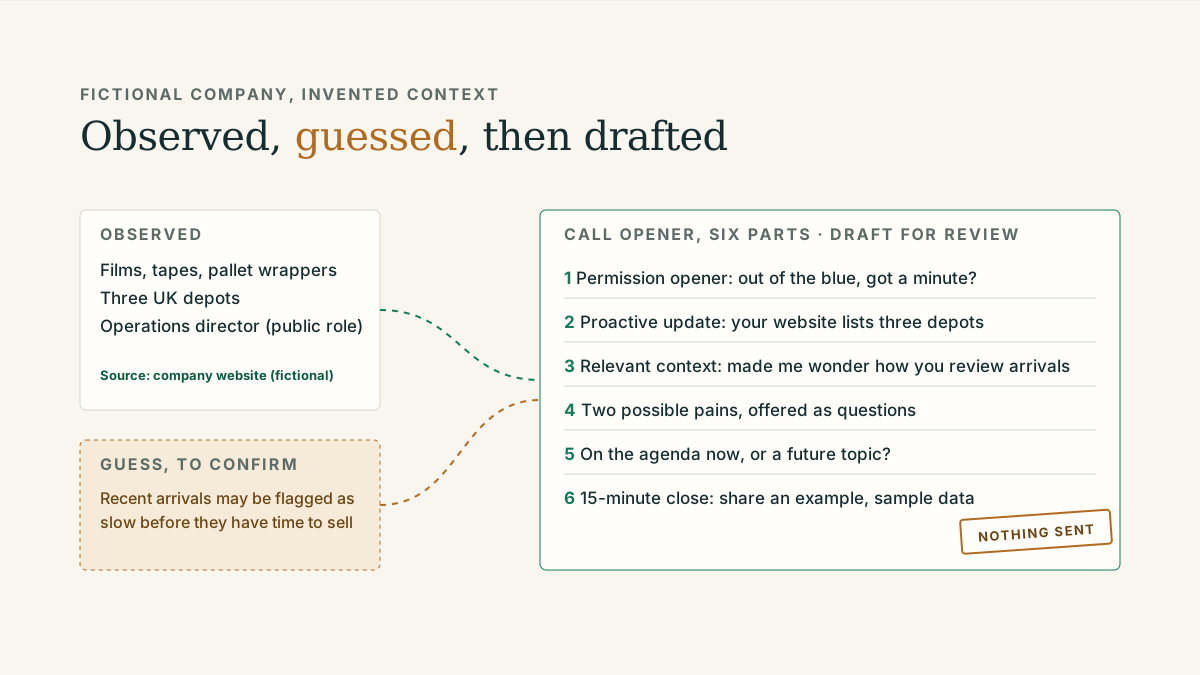
Write preparation notes in two columns. In the first, things you can point to: “the website lists three warehouse locations”, “the product range includes machinery and consumables”, “the role is operations director”. In the second, what you suppose from them: “probably holds stock in several places and may have visibility problems across sites”. Label the second column as inference. On the call, the first column is something you can say out loud. The second column is a question, never a statement.
Avoid creepy personalisation
Personalisation has a narrow useful band. Referring to a company’s published change, a role’s typical concerns, or a business post the person has published, accurately attributed, is relevant. Implying an introduction or endorsement that did not happen, or referring to anything about their private life, is not. A simple test: would you be comfortable if the person could see your preparation notes? If not, cut the line.
Appropriate sources
- The company’s own website and product pages.
- Public company filings and press releases, where they exist.
- The professional profile the person has published, read for role and responsibilities only.
- Your own records of previous contact with the company, if any.
What is not appropriate: private data, scraped contact lists, anything that requires guessing at personal characteristics, and “verified” phone numbers from sources you cannot vouch for. Preparation should be defensible to the person you are calling.
The six-part call structure
- Permission opener. Acknowledge the call is out of the blue and ask for a moment.
- Proactive update. One sentence on why you are calling now, tied to something real.
- Relevant context. A peer or company situation the person will recognise, stated as observation.
- Two specific pains. Two possible issues, each phrased as a question, not a diagnosis.
- The agenda question. “Is that on the agenda now, or a future topic?”
- The 15-minute close. Offer a short conversation to share a relevant example or insight.
The structure gives the prospect room to say no at every step and to correct the assumptions, which helps the seller adjust rather than press on.
An invented sample call
Fictional example. Invented company, unnamed person.
Context (observed): Northfield Packaging Supplies (fictional) lists films, tapes and pallet wrappers, three UK depots, and an operations director on its team page. Inference (labelled): with stock across three depots, recent arrivals may be flagged as slow before they have had time to sell, and a change in repeat orders may be hard to see in one report.
- Permission opener: “I know this is out of the blue. Have you got a minute, and if not, when would be better?”
- Proactive update: “I work with packaging distributors on the reporting side of stock and customer orders. Your website lists film and machinery across three depots.”
- Relevant context: “That made me wonder how you review recent stock arrivals and changes in repeat orders across the three sites. I do not know your setup, so tell me if this is off the mark.”
- Two specific pains: “Two things I would guess at, and you can tell me I am wrong. First, whether recent arrivals get flagged as slow stock before they have had time to sell. Second, whether a regular customer’s orders dropping off is noticed before the quarter end.”
- Agenda question: “Is either of those on the agenda now, or more of a future topic?”
- 15-minute close: “If it is worth a look, I could share what a checked weekly review looks like in fifteen minutes, with sample data. No preparation on your side.”
Nothing about the person appears in the script. The one observation comes from the company’s public pages; everything else is offered as a guess the person can correct.
A concise email
Fictional example, for human editing before it is sent
Subject: Slow stock across three depots
Hello,
Out of the blue, so I will keep this short. I work with packaging distributors on sales and stock reporting. Your website lists film and machinery across three depots, which made me wonder about two things: whether recent stock arrivals get flagged as slow before they have had time to sell, and whether a regular customer’s orders dropping off is noticed before the quarter end. I do not know whether either applies to you.
If either of those is on the agenda, I would be glad to share what a checked weekly review looks like in a 15-minute call, using sample data. If it is a future topic, a one-line reply saying so is welcome too.
Kind regards
About a hundred words, one observation, two possible issues, one small ask. Nothing in it is about the person.
Human judgement
Preparation notes, scripts and drafts are inputs to a conversation, not the conversation. The salesperson decides whether the inference holds, whether the timing is right, and what to say when the person disagrees. Any tool that helps with preparation should make the sources visible and the inferences obvious, so the person using it can review and correct it.
Where a Sales Sidekick fits
A Sales Sidekick is a bespoke browser companion that helps a salesperson do the preparation above in one place: review the profile and company context they choose, organise source-linked notes, record possible issues as labelled inferences, and draft an opener or first email for editing. It is available to scope and build for a sales team, with the browser workflow, sources and access agreed for each build. It does not send anything, and it is not a substitute for the salesperson who owns the relationship.