Four questions from a buyer
Picture a buyer, invented for this article, at a food manufacturer putting an order together late on a Friday. Four things are in the way:
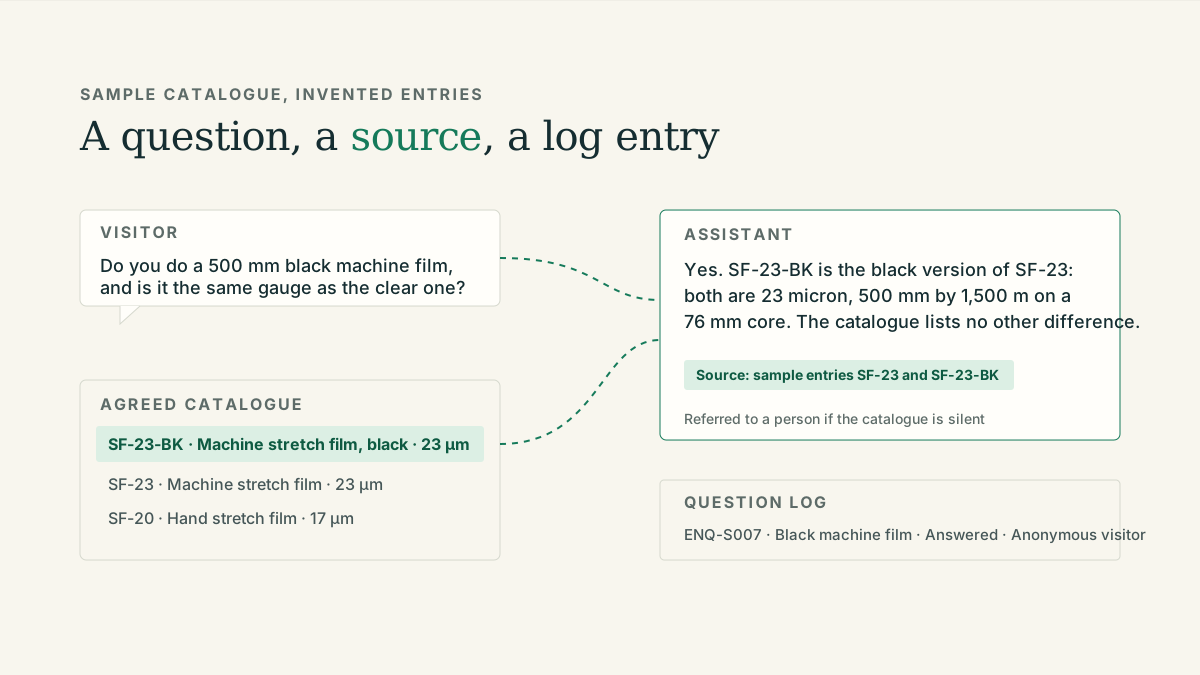
- “Do you do a 500 mm black machine film, and is it the same gauge as the clear one?”
- “What is the difference between these two codes? They look identical.”
- “Will your wrapper take a 2.1 metre pallet?”
- “Do you still stock parts for the older model we bought a few years ago?”
Each is a different kind of question. The first is navigation: the buyer does not know what you call the product. The second is comparison, and the catalogue probably answers it if the two entries are read side by side. The third needs a specialist, because it depends on the buyer’s site and loads. The fourth exposes a content gap: the part may exist, but it is not on the website. Left alone, all four become a phone call, an email or an order placed with someone else.
Navigation by conversation
Catalogue navigation assumes the visitor knows the category name. A conversational assistant lets them start from the job instead: “film for wrapping pallets by hand” can be walked to the right entries even when the visitor has never heard the words hand stretch film. The point is not to replace the catalogue pages but to get the visitor to the right one faster, and to offer the obvious next step, such as a comparison with the machine films.
Answers that show their source
An answer is only useful to a trade buyer if they can trust it. The simplest way to earn that trust is for every answer to name the catalogue entry it relies on. In the sample catalogue used in our guided demo, that reads: “the catalogue lists SF-23 as 23 micron, 500 mm by 1,500 m on a 76 mm core”. If the entry is wrong, the answer is wrong in a way anyone on the team can see and correct at source. An assistant configured around agreed product content, rather than the open web, makes this practical.
The comparison question is where source-backed answers earn their keep. Set out the fields the catalogue actually states, say which one differs, and say nothing about the ones it does not cover.
Recognising unknowns
The pallet-height question is a good example of a question the assistant should not answer alone. The catalogue may state the machine’s maximum pallet height, and the assistant can quote it, but whether the machine suits the buyer’s site is a judgement for a person. A useful assistant says so, offers to pass the question to a sales specialist, and, if the visitor wishes, takes a name and email so the reply can reach them. Prices and stock levels belong in the same category unless a live integration has been agreed and built.
Handover is not a failure of the assistant. It is the assistant doing the part of the job it can do well, which is to arrive at the specialist’s desk with the question already clear.
A backlog worth reading
Every question, answered or referred, goes into a log the team can read. The useful columns are few:
Illustrative example, invented entries
| Question as asked | Topic | Outcome | Source cited | Contact details |
|---|---|---|---|---|
| “Do you do a 500 mm black machine film?” | Product navigation | Answered | Sample entry SF-23-BK | Not offered |
| “Will your wrapper take a 2.1 m pallet?” | Machine suitability | Referred to specialist | Sample entry SW-1 (height quoted) | Offered by visitor |
| “Do you still stock parts for the older model?” | Spares | Referred: not in catalogue | None found | Offered by visitor |
| “What is the price of PT-12?” | Pricing | Referred: pricing not held | Sample entry PT-12 (description only) | Not offered |
Contact details appear only when the visitor chose to provide them. The assistant does not identify anonymous visitors, and what is collected and for how long is agreed for each implementation.
Read weekly, this table does two jobs. Referred rows with contact details are a follow-up list. Referred rows marked “not in catalogue” are a to-do list for whoever maintains the product content.
Fixing the catalogue from the questions
When the same question is referred three weeks running because the catalogue does not cover it, the fix is rarely in the assistant. Add the missing specification, list the spare part, state the pallet height, and the next visitor asking the same thing can be given an answer with a source. Keep the history, and after each round of catalogue changes review whether unresolved or repeated questions have reduced. A log of every question will keep growing; the useful measure is whether the same gap keeps appearing.
A packaging supplier example
A website assistant was built and demonstrated for a UK supplier of packaging products, configured around the supplier’s own product information, with product questions and enquiry capture as the focus. The guided demo on the website AI agents page shows the style with an invented catalogue.
A proposed operating workflow
For a new implementation, these points are agreed with the client before the assistant goes live:
- Agree the knowledge sources: catalogue pages, data sheets and approved FAQs. The assistant is configured around that set.
- Agree the boundaries: what it must not answer, and the wording it uses to refer a question.
- Agree the handover: who receives referred questions, and what a visitor may choose to leave behind.
- Name an owner for the weekly log review, and decide how catalogue fixes flow back into the assistant.
- Check sample answers against the catalogue with the team before it goes live, including the questions it should decline.
The service is described in full on the website AI agents page.